
2026.01.26
[Industry Survey] More Than Half of Contract and Transaction Management in the Logistics Industry Still Relies on Paper and Excel
54.8% Have Experienced Issues—Legal Reforms Expose the Limits of Person-Dependent Management
Trouble Spikes Once Monthly Case Volume Exceeds 50. Automation and standardization that prioritize cost, usability, and legal compliance are urgently needed
Logitec Inc., a member of the Camcom Group that addresses social issues related to “work” through business (hereinafter “Logitec”; Head Office: Shinjuku-ku, Tokyo; President & Representative Director: Takashi Nawata), conducted a survey of shipper companies from August to September 2025 titled “Survey on the Current State of Contract and Transaction Management in Logistics Operations.” The results revealed that 55% of contract management still relies on paper documents and Excel. As the two logistics-related laws revised in 2024 (*1) require clearer contract terms and fairer transactions, the reality has become evident that person-dependent contract management is leading to operational issues and management risks.
In the logistics industry, amid driver shortages and rising costs, the importance of contract and transaction management is increasing further. Meanwhile, on the ground, issues such as “we can’t find where the contract is kept” and “we can’t track the history of term updates” have been left unresolved for years. From its position of providing ongoing support to shippers, logistics companies, and warehouse operators, Logitec conducted this survey to visualize the actual state of contract management and its challenges.
*1: Refers to the “Act on Comprehensive Efficiency of Logistics (Act on Logistics Efficiency)” and the “Motor Truck Transportation Business Act.” Revised law enforced on April 1, 2024 by the Ministry of Land, Infrastructure, Transport and Tourism.
The full survey report is available for download from the link below.
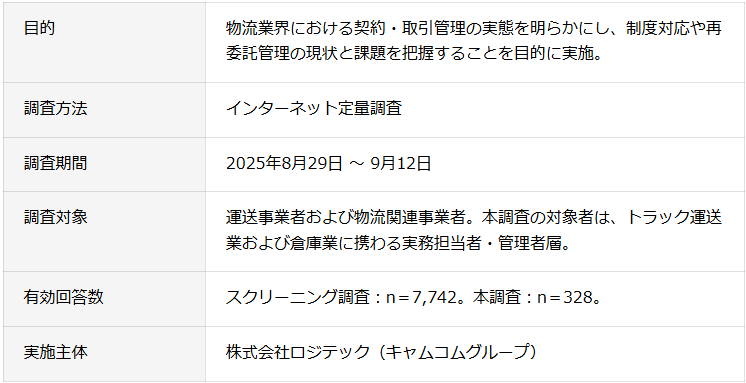
Survey Overview
Summary of Findings
1.More than 53% of contract management relies on “paper and Excel”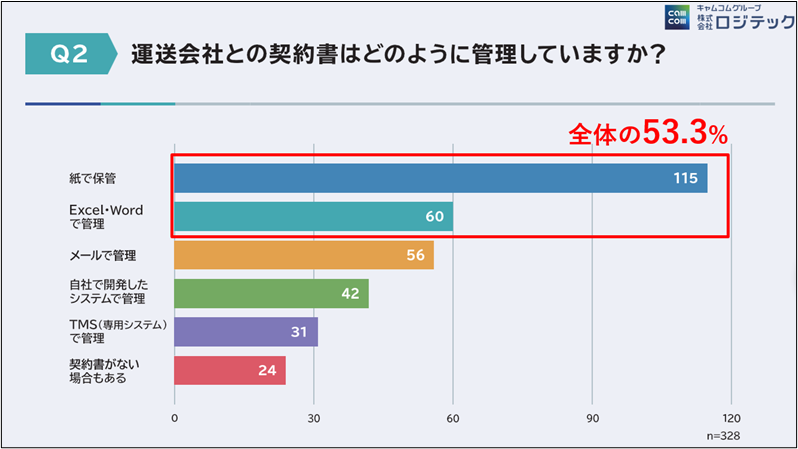
For contract document management with carriers, approximately 35% reported “stored on paper,” and about 18% reported “managed in Excel/Word.” In total, more than half (53.3%) rely on analog methods combining paper and Excel—highlighting an outdated reality. With these methods, managing revision histories, enabling searchability, and responding to audits impose a significant burden.
2.More than half of companies have experienced “contract- and transaction-related issues”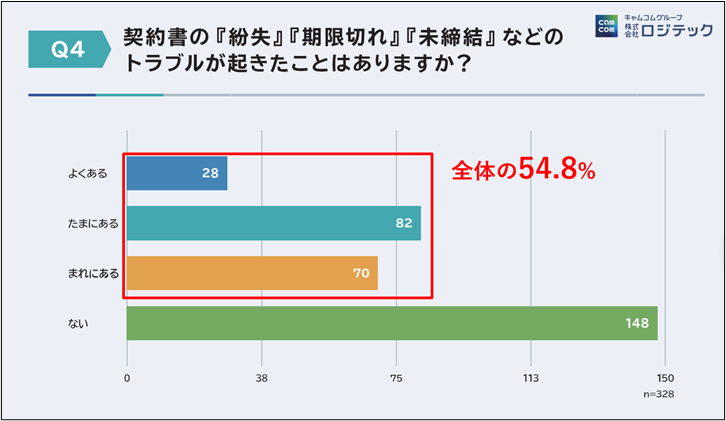
54.8% reported having experienced contract-related issues such as “misunderstandings of contract terms,” “missed renewals,” and “unclear scope of responsibility.” This suggests that deficiencies in contract management affect not only daily operations but also business relationships. In particular, once the number of monthly transport/delivery cases exceeds 50, the incidence rate of issues increases sharply, and the frequency and severity of issues tend to be highest in the range of 101–500 cases. These results indicate that once case volume surpasses a certain threshold, the limits of person-dependent management become pronounced.
3.A deep gap between “awareness” and “execution” in responding to legal reforms
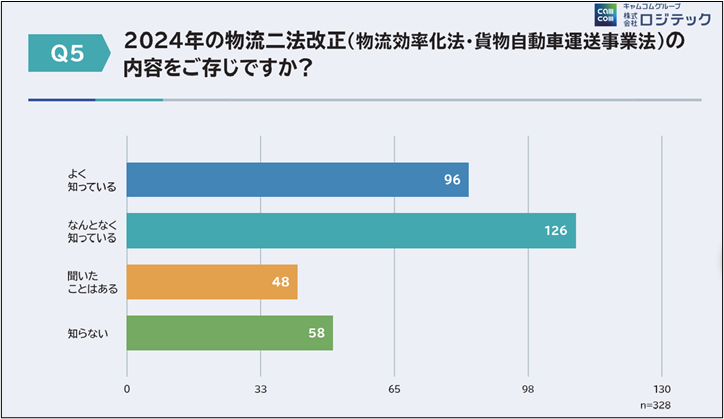
While a certain number of companies answered that they “understand the content” of the logistics-related legal reforms, only a limited number have been able to reflect this understanding in contract management and operational workflows. Although awareness is progressing, many companies are stalling at the execution stage due to reasons such as “we don’t know where to start” and “we can’t change existing operations.”
4.Keys to system adoption: “cost,” “usability,” and “legal compliance”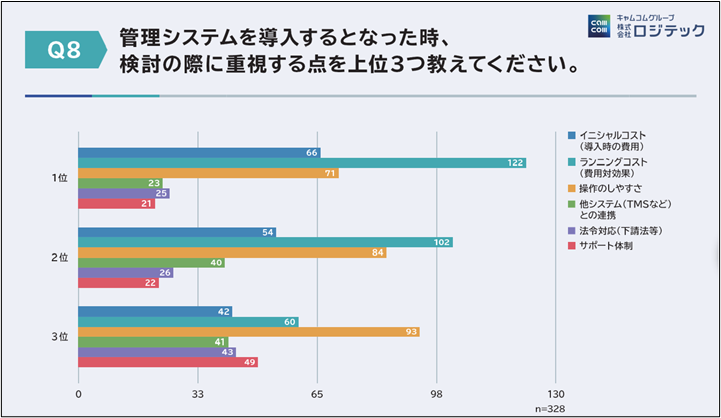
When considering contract management systems, the top priorities cited were “initial cost (implementation cost),” “running cost (implementation and operational cost),” “ease of operation,” and “compliance with laws and regulations.” Even if a system is highly functional, adoption will not progress if “the cost burden is too high,” “it cannot be used effectively on-site,” or “it cannot keep up with legal reforms.” The findings show that there is strong demand for mechanisms that can be adopted and sustained in day-to-day operations.
Challenges and Implications Revealed by the Survey—The Next Step Toward Minimizing Contract Risk
This survey indicates that challenges in contract management within the logistics industry are no longer merely an administrative efficiency issue, but are increasingly becoming a management risk in themselves. In particular, from the perspectives of “clarifying contract content due to legal reforms,” “accountability for explaining transaction terms,” and “evidence management when issues occur,” paper- and Excel-based management has clear limitations.
Contract management improvements tend to be deferred amid simultaneous demands such as responding to legal reforms; however, the survey also highlights that this topic directly impacts the reduction of transaction risk and the accuracy of decision-making. The results suggest that the next step toward minimizing contract risk is transitioning to a management structure that does not rely on person-dependent operations.
Logitec’s Initiatives and Future Direction
Based on the survey results, Logitec will promote the reduction of operational risk across the logistics industry through the standardization and digitalization of contract management. Going forward, Logitec will support initiatives such as centralized management of contract information, history management of renewals and condition changes, and the establishment of management structures linked to operational workflows, contributing to the logistics industry by building systems that anyone can operate continuously.
Full Survey Report—Detailed findings also available on “LogiPalette Journal”
Detailed analytical results and specific case studies from this survey are published on “LogiPalette Journal,” a logistics information media outlet operated by Logitec.